Energy

Connectivity Gaps Are a Critical Risk in Energy Operations

Secure, reliable, and interference-free private 5G and LTE for the energy sector’s most demanding environments, from LNG facilities to refineries, midstream sites, upstream sites, and nuclear facilities. 

The Industry's Challenge

Connectivity Gaps Are a Critical Risk in Energy Operations

Oil, gas, and energy facilities operate across vast, remote, and often hazardous footprints where reliable connectivity is not a convenience; it is a safety and operational imperative. Connecting SCADA systems, remote sensors, smart meters, and IoT devices without interference, without dependence on public carrier networks, and without extensive fiber infrastructure has long been one of the sector’s most persistent challenges.

Traditional connectivity options consistently fall short. Wi-Fi degrades in heavy metal environments and requires an impractical number of access points across large industrial sites. Public carrier networks introduce security exposure and are unreliable in remote or offshore locations. Satellite connectivity is typically not fit for multiple devices spanning an entire site, with congestion during an emergency. Fiber buildouts are expensive, time-consuming, often over a year to deploy, and inflexible as site layouts evolve. The result is that most energy operators are stitching together multiple imperfect solutions and still ending up with gaps.

THE SOLUTION
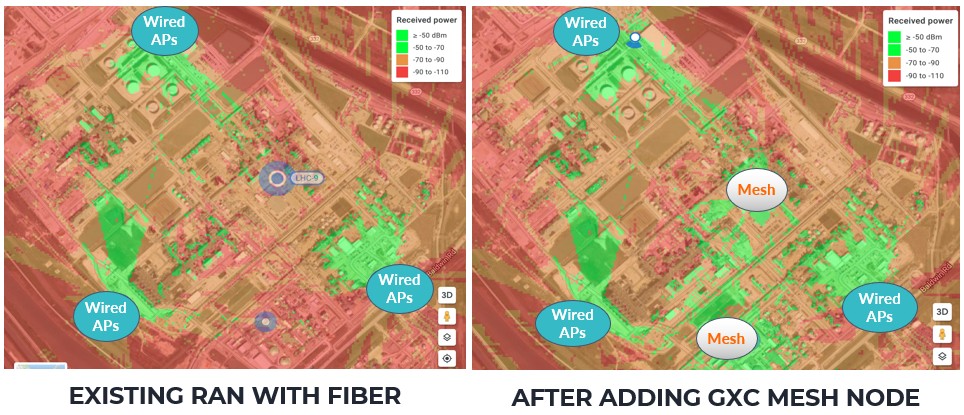
Purpose-Built Private Cellular for Energy Infrastructure

GXC is an end-to-end private 5G and LTE network built specifically for mission-critical industrial environments, combining purpose-built radios with a centralized management platform that gives your team full visibility and control across the site. For facilities with especially difficult terrain or hard-to-reach areas, GXC's patented Cellular Mesh technology can extend coverage even further using only power, including areas where fiber, LAN, and public carrier signals are unavailable or inadequate.

Bring your network online in days, not months, and reconfigure it as your site evolves without costly re-engineering.

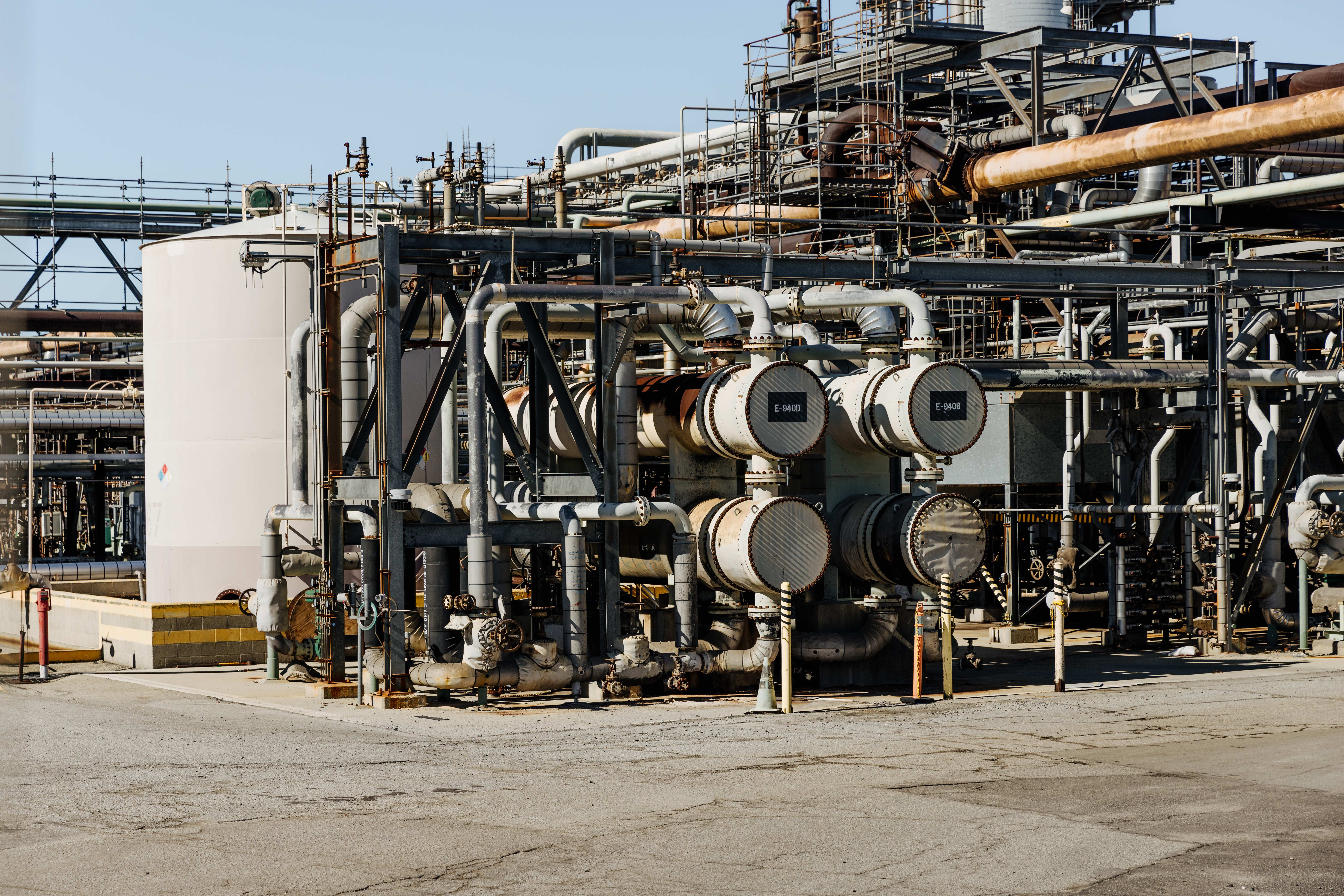
Refinery Deployment: Two mesh nodes minimized network infrastructure and provided coverage through dense process units and pipe racks, enabling real-time monitoring of critical assets for safer, more efficient operations. GXC can extend an existing network into these hard-to-reach areas, or grow alongside the site as new zones come online, without a new buildout each time.

In The Field: Active Deployment Upstream Oil & Gas, West Texas​

The Environment

A remote drilling operation in West Texas with multiple active rigs, modular field offices, control rooms, and support equipment spread across a large open site with no existing LAN infrastructure and limited public carrier coverage.

The Challenge

The site needed reliable, low-latency connectivity for rig control systems, sensor telemetry, and crew communications across a footprint where fiber was not available and carrier signal was inconsistent at best.

The GXC Solution

GXC deployed a single radio mounted on existing site structures, bringing private cellular coverage online across this pad and the adjacent one without requiring any fiber backhaul, replacing what had previously required 10 Wi-Fi access points. Control room screens, field devices, and mobile equipment all connect on a single dedicated private network. The connectivity also made it possible for the crew to run video calls and Teams chats on site for the first time. With reliable connectivity in place, the team built new applications that send data from the rig site back to Houston, where it is processed to help optimize drilling operations, with results delivered back to the site.

Use Cases GXC Enables Across the Energy Sector

real time machine monitoring

SCADA & Remote Monitoring

Real-time visibility into facility operations, pipeline pressure, valve status, and environmental sensors, without fiber or public carrier dependency.

Predictive
Maintenance

Continuous equipment health data feeds maintenance teams before failures occur, reducing emergency interventions and turnaround time.

smart-meter

IoT & M2M
Integration

Wireless integration of smart meters, flow sensors, and asset tags across the full site footprint with low latency and high device density.

Autonomous Robots & Equipment

Reliable, low-latency connectivity for autonomous ground vehicles and robotic systems operating across the site, supporting navigation, safety, and real-time data exchange.

Security & Video Surveillance

High-bandwidth, private connectivity supports HD video monitoring across large perimeters and hazardous zones without reliance on public networks.

enhanced network icon

Environmental Monitoring

Automated outage detection, emissions tracking, and compliance reporting via connected sensors, with real-time alerts to operations teams.

network segmentation icon

Disaster Recovery & Continuity

Rapidly deployable network nodes restore communications quickly after outages or events, keeping critical operations online.

Remote Support & Troubleshooting

Always-on connectivity enables remote diagnostics and guided repair for field equipment, reducing the need for on-site specialist travel.

training icon

Connected Worker Safety

Personnel tracking, two-way communications, and wearable device connectivity in high-risk zones keep field teams safer and better coordinated.

WHO IS THIS FOR

People Who Feel This Problem Every Day

Connectivity decisions in the energy sector rarely come from a single person. Procurement, IT, operations, and engineering all have a seat at the table, and each of them is solving for something slightly different.

VP of Operations / Plant Manager
Senior operational leadership at refineries, LNG terminals, or upstream sites

Uptime and output. An unplanned outage at a refinery can cost $250,000 or more per hour, and connectivity failures that interrupt SCADA or remote monitoring are a direct cause. They want a network that works reliably at scale and does not require their team to babysit it.

GXC removes the patchwork. One private cellular network covers the full site, supports real-time monitoring, and stays up even when individual nodes go offline. It is a direct line to fewer incidents and lower downtime costs.

IT / OT Director or Network Engineer
Infrastructure and technology leads responsible for plant connectivity and cybersecurity

Security isolation, network reliability, and the ability to integrate with existing OT systems like SCADA and DCS, as well as existing devices such as tablets and phones. They are skeptical of public carrier exposure and frustrated by Wi-Fi’s limits in high-interference metal environments. Above all, they want their own data, not a black box managed by someone else.

GXC runs on dedicated spectrum, never touches a public carrier, and gives IT full visibility through the Onyx management portal. It integrates cleanly with existing OT infrastructure and connected devices, and operates as a private, auditable network from end to end. Less time spent babysitting the network translates into fewer support tickets for the team.

HSE Manager
Safety and compliance leads at upstream, midstream, and downstream energy facilities
Worker safety in hazardous zones, reliable communications during emergencies, and the ability to track personnel in real time. A connectivity gap in a high-risk area is not just an operational problem; it is a safety liability.

Private cellular supports personnel tracking, wearable device connectivity, and real-time two-way communications in zones where Wi-Fi coverage is inconsistent. When something goes wrong, the network stays up.

Installation-Site_OilandGas_Private5G

Project / Construction Manager
Leaders managing capital projects, facility buildouts, or turnarounds at energy sites
Speed, flexibility, and cost. They need connectivity on site from day one of a project, cannot wait months for a fiber build, and need the network to move with the project as phases change. After the project wraps, they want the network to be redeployable elsewhere.

GXC deploys in days with no fiber required. Nodes can be repositioned as the site evolves. And when the project is done, the hardware does not sit idle, it can be picked up and redeployed at the next job, or handed over to the client with ease.

CIO / CTO
Executive technology leadership at integrated energy companies or large operators
Strategic infrastructure decisions, vendor consolidation, and total cost of ownership. They are evaluating private cellular as part of a broader digital transformation roadmap and want to know that a solution can scale across multiple sites.

GXC is a single platform that scales from one site to many. It supports current operational needs and is ready for the next wave of IoT and AI-driven applications without requiring a rip-and-replace.

What Operators Are Actually Dealing With

Every sub-vertical in the energy sector has its own version of the connectivity problem. The details differ, but the underlying issue is the same: the existing options were not built for how energy infrastructure actually works.
LNG Terminals & Liquefaction

LNG facilities often sit on coastal or remote sites where public carrier coverage is poor to nonexistent. The cryogenic processes running inside demand continuous monitoring, and a communications gap near high-pressure liquefaction equipment is not just an inconvenience; it is a safety event waiting to happen.

Wi-Fi struggles across the sprawling outdoor footprints of most LNG sites, and the dense metal structures around storage tanks and loading arms make signal propagation even harder. Most operators end up relying on a mix of fiber runs, point-to-point radios, and satellite backhaul, all of which add complexity and introduce single points of failure.

Private cellular can also extend coverage to the terminals and port areas of an LNG facility, supporting monitoring and connected workers throughout loading and berthing operations.

What they need is a single network that covers the full terminal footprint, keeps safety systems online, and does not depend on public infrastructure that was never designed for this environment.

Oil & Gas Upstream

Exploration and production sites are often the furthest from existing infrastructure, and connectivity is typically an afterthought bolted on after the site is already operational. Satellite is the default fallback, but high latency makes it poorly suited for real-time SCADA or safety communications. Temporary solutions get extended indefinitely.

Where satellite, including Starlink, is already in place as backhaul, GXC extends that connection to significantly more devices across a wider footprint than satellite alone can support. Overall latency is still set by the backhaul link itself, but the density and reach GXC adds on top of it is where the value is.

As sites move from exploration to production, connectivity requirements change fast. The network needs to grow with the operation, support more devices, cover more ground, and handle data from an increasing number of sensors and meters without requiring a completely new build each time.

Refineries & Petrochemicals

A modern refinery can span thousands of acres with hundreds of thousands of sensors, valves, and control points. Wi-Fi access point density requirements in these environments are enormous, and the interference created by heavy metal structures, process equipment, and competing RF sources makes reliable coverage extremely difficult to maintain.

Turnarounds are one of the biggest pain points. Bringing in a large contractor workforce for a major maintenance event creates a sudden spike in connectivity demand, and the existing network rarely has the capacity or coverage to handle it. Connectivity becomes a constraint on turnaround speed, which translates directly to lost production time.

Security is also a growing concern. As refineries add more connected devices, the risk of OT network exposure increases. Many operators are actively looking for ways to air-gap their operational technology from anything touching a public network.

Midstream: Pipelines & Compression

Pipelines present a fundamentally different connectivity challenge than a contained facility. The infrastructure is linear, often spanning hundreds of miles, and a significant portion of it runs through areas with no commercial carrier coverage at all. Compression stations, metering points, and valve actuators all need to communicate back to a control center, and right now many of them do so through aging radio systems or expensive satellite links.

As regulatory pressure on pipeline monitoring and leak detection increases, operators are being pushed to instrument more of their network with sensors that require real-time data transmission. The existing communications infrastructure was not designed for that volume of continuous, low-latency data.

Power Generation & Utilities

Grid modernization is creating a connectivity gap at power generation facilities. Distributed energy resources, smart inverters, and demand response systems all require reliable, low-latency communications, but many generation facilities were built before those requirements existed. Adding them to the existing network creates security concerns and often requires significant infrastructure investment.

Utilities depend on connectivity most in the moments it is hardest to get: emergencies and high-demand events, when public networks tend to become congested and monitoring systems need to stay online the most. A dedicated private network, run alongside or as a backup to existing infrastructure, keeps critical monitoring and communications available when the grid is under the most stress.

For peaker plants and backup generation facilities that only run during high-demand periods, deploying and maintaining a permanent fiber or carrier connection for a site that runs a fraction of the year is hard to justify economically. They need a connectivity option that is cost-effective even at lower utilization rates.

Nuclear Facilities

Nuclear sites operate under stricter regulatory and cybersecurity requirements than any other energy sub-vertical. Any network touching operational systems must be fully isolated from public infrastructure, auditable, and capable of demonstrating compliance with NRC and other applicable standards. Public cellular is a non-starter for most OT applications in this environment.

Physical security is equally demanding. Personnel tracking, access control communications, and perimeter surveillance all need to run on a network that is both highly reliable and completely isolated. Most nuclear facilities manage this today with a patchwork of legacy systems that are expensive to maintain and difficult to upgrade.

Data Centers

Large data center campuses share many of the same connectivity challenges as industrial energy sites. Coverage across a multi-building campus with dense concrete and metal construction is difficult for Wi-Fi, and reliance on public carrier networks for internal operations creates security exposure that most operators want to eliminate.

As data center density increases and power consumption becomes a critical operational variable, the need for real-time monitoring of cooling systems, power distribution, and environmental conditions is growing. That monitoring infrastructure needs a reliable, low-latency network that can support a high density of connected devices across the full campus footprint.

Owning Your Cellular Network in Your Facility

What Makes GXC Different

GXC provides a private cellular network, where the distinction matters most in environments like yours, e.g., site footprints are expansive, infrastructure is sparse, and downtime is never an option.

<10ms Latency  |  Support 1,000+ Devices  |  High-Bandwidth  |  Fast Deployment

Enterprise-Grade Security

SIM authentication and enterprise-grade encryption at every layer. You own the entire network and every byte that crosses it, with no public carrier in the middle.

Built for Mobility

As workers move around the site and behind metal structures, they stay connected. Built for how people actually work, connectivity that moves with your team, not just fixed points on a map.

Lower Total Cost

Full site coverage at lower cost than public networks, competitors, Wi-Fi, or satellite. Fewer access points, faster deployment, and reduced network management overhead translate directly to OpEx savings.

Network Flexibility

Redeploy or expand as project phases, production zones, or operational priorities shift, without infrastructure lock-in.

Interference-Free Operations

Dedicated spectrum means zero competition from nearby Wi-Fi, consumer devices, or public carrier congestion.

Reduced Downtime

A resilient, self-healing network design and predictive maintenance support minimize unplanned outages and their downstream cost.

Real-Time Data Collection & Connectivity

Low-latency M2M communication and IoT integration for SCADA, remote sensors, and control systems. Connect new and existing field devices, from sensors and cameras to controllers, tablets, and phones, for reliable site-wide visibility and communication.

Centralized Network Management

Manage every radio, connected device, and SIM from the Onyx portal. Customize bandwidth allocation, set network alerts, and view a full audit log, all from a single pane of glass.

Full-Site Coverage

Extend connectivity to remote corners, outlying structures, and mobile assets where Wi-Fi and fiber fall short, with minimal added infrastructure. C1D2-certified and pressure-tested for the harshest conditions: heat, dust, vibration, and hazardous areas.

Connect with us to Get Started

GXC is the only mesh-based private cellular provider in the world. If your facility needs reliable, secure, and flexible connectivity across a complex or remote environment, we would like to show you what GXC can do.

Contact Sales

Our sales team is available to provide expert advice on our products at anytime.

Try our Technology

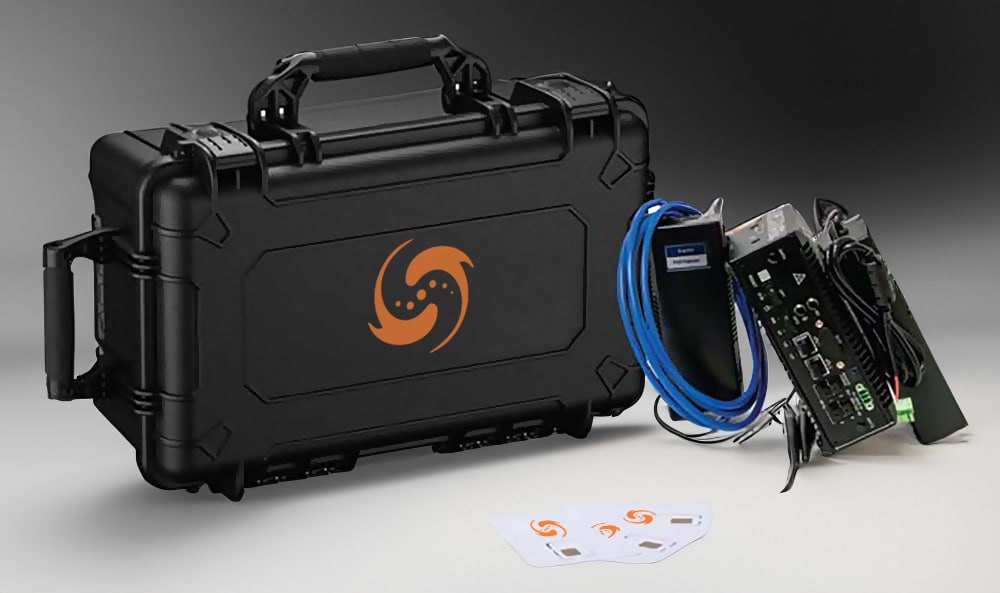
Unlock LTE and 5G technology potential with our solution. Get a free demo or buy a starter kit today.

Become a Partner

Our program is designed to empower partners with tools, training, and support to deliver solutions and services to their clients.